Gold is heavy
Most guides start with shop prices and forget the mechanic that decides whether you are rich or broke: 400 gold pieces equal one kilogram. Gold is not a score here; it is an inventory item with a weight, competing with your weapons for space.
Your carry limit is Strength multiplied by 1.5 kilograms. Strength 60 gives you 90 kilograms, which is 36,000 gold; Strength 30 gives you 45 kilograms, which is 18,000. That gap is not 18,000 gold of shopping power, it is loot capacity: the extra weight also has to carry the salvage you are hauling out of the barrow.
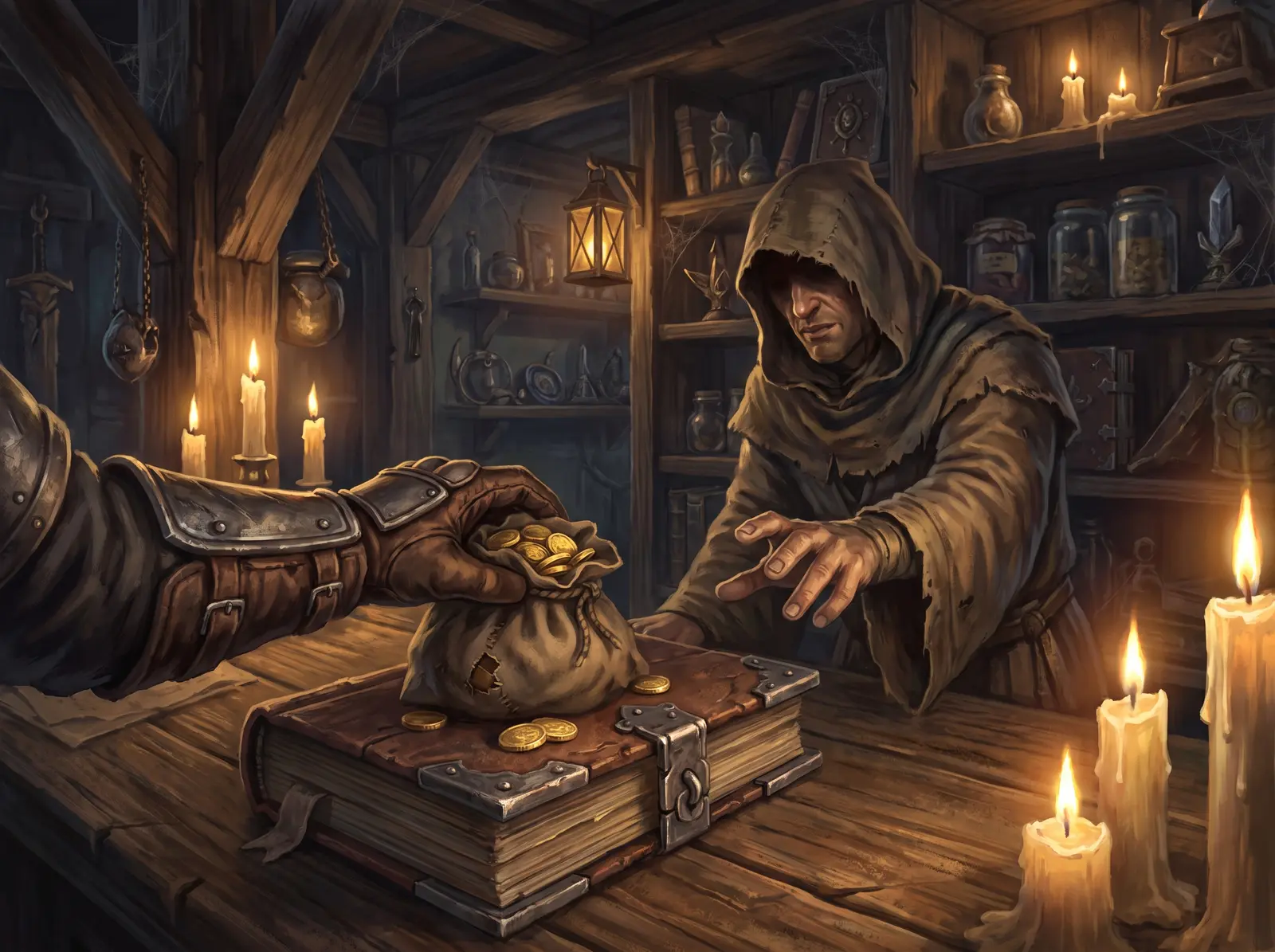
So when people call themselves rich, they usually mean they are carrying a banknote they cannot pick up. Three mechanisms fix that: a cart holds 750 kilograms and travels with you, a letter of credit turns a fortune into a 0.25 kilogram document for one percent, and a bank loan lets you spend gold you have not looted yet.
Do your shopping arithmetic in kilograms, not in gold. Ask how much of your load is coins. If coins are a large share of it, the answer is a letter of credit, not a better shop.
The store reference
Thirteen service types run the Iliac Bay. The reference sources state hours for only three of them, so the rest are marked Not stated and the region page is where you look. Learn the names: much of this game's best advice is knowing a Furniture Store is a Thieves Guild front, not a place to buy a cupboard.
| Service | What it sells | Hours | Who runs it |
|---|---|---|---|
| Weapon Smith | Weapons and armour. Buys, sells and repairs both. Repairs take one or more days. Buys magical weapons but never sells them. | 09:00 - 20:00 | Independent tradesman |
| Bank | Loans, letters of credit, ship purchases | 08:00 - 15:00 | The regional bank |
| Alchemist | Ingredients, gems and magical gems. Metals. Never sells potions. | 07:00 - 22:00 | Independent tradesman |
| Gem Store | Gems, jewellery and small valuables | Not stated | Independent tradesman |
| Bookstore | Books and tomes | Not stated | Independent tradesman |
| Library | Reading access, and book trade in some towns | Not stated | Public institution |
| Clothing Store | Garments and cloth | Not stated | Independent tradesman |
| Furniture Store | Household goods. A Thieves Guild front. | Not stated | Front for the Thieves Guild |
| General Store | Mixed goods, plus horses (1,000g) and carts (150g) | Not stated | Independent tradesman |
| Pawn Shop | Buys items outright, cash on the spot | Not stated | Independent moneylender |
| Shopping Plaza | Several stores clustered in one district | Not stated | Municipal district |
| Tavern | Food, drink, rooms, rumours and rumours with loot attached | Not stated | Independent innkeeper |
| Armorers | Armour, shields and armour repairs | Not stated | Independent tradesman |
Shop quality decides the stock
Every store carries an internal quality rating on a 1 to 20 scale, and that rating decides what it stocks. It is why a general store in Shornhelm and one in a rich capital are not the same shop at different prices. When a shop lacks what you want, a bigger town is a legitimate answer. Our travel guide covers crossing the province quickly.
Weapon Smiths are the only vendor who both buys and repairs armour and weapons, and repairs take one or more days. That makes them the most important building in any town you plan to fight in. Banks shut at 15:00 and are the only place you can take out a loan or buy a ship.
What to sell where
Selling everything to the first counter you see is how you lose half your income without noticing. Each counter pays best for the category it exists to handle, and before you dump a pile on one counter, identify your items: unidentified loot sells for a fraction of what it fetches once identified.
| What you pulled | Sell it to | Why | Watch out |
|---|---|---|---|
| Weapons, armour, shields | Weapon Smith (09:00-20:00) or Armorers | Both categories under one roof, plus repairs | Buys magical weapons but never sells them, so you never replace a magic blade here |
| Gemstones, jewellery | Gem Store | The counter that values them properly | Never buy back what you just sold |
| Ingredients, metals | Alchemist (07:00-22:00) | Buys ingredients, gems and magical gems, and stocks the metals nothing else carries | No potions, ever. Ingredients only |
| Books and tomes | Bookstore or Library | Specialist counters for written material | Check the region page for which towns have which |
| Household goods, furniture | Furniture Store | Also your way into the Thieves Guild without a referral | The shop is a front; the counter is the desk |
| Mixed junk | Pawn Shop or General Store | Cash on the spot, no identification needed | Which pays more is community opinion, not documented data - test it |
Identification itself is a service you can buy inside a guildhall, which is the cheapest upgrade to your income in the game.
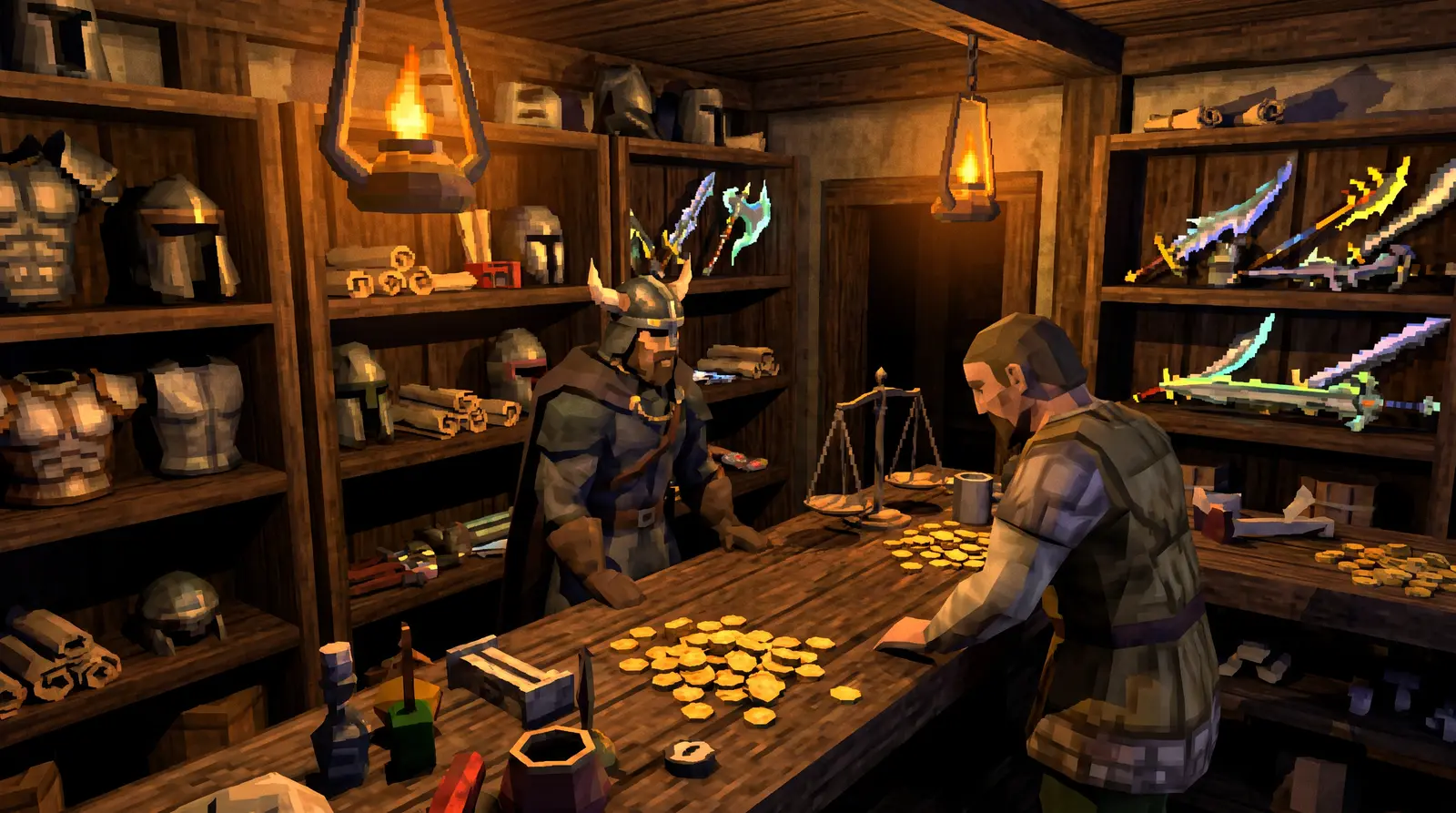
The barter skill
Daggerfall calls it Mercantile, and every haggle runs through it. None of the following is speculation:
- Governed by
- Personality. The one stat investment that reliably improves your prices.
- Training rate
- Twice the normal rate, from any source, use or trainer.
- Build importance
- Major skill for the Burglar. Minor skill for the Nightblade and the Thief.
- Taught by
- The Resolution of Zenithar.
- Required by
- The School of Julianos and the Resolution of Zenithar.
- Trainer ceiling
- A trainer can raise a skill only to 51. Past that you are on your own.
- Training cost
- 100 gold multiplied by your level, per session. A real budget line, not a free action.
Put those together and the plan is obvious: Personality early, then Mercantile trained to 51 through Zenithar while the trainer is reachable, then stop paying and let use do the rest. A session costs 100 gold times your level, so when you train is itself a financial decision. Settle attribute points first: our character creation guide covers where Personality sits next to Strength, and Strength decides whether you can carry the money you earn.
Train Mercantile early, while sessions are cheap. A level 12 character pays 1,200 gold for a session; the same session at level 40 costs 4,000. Bank the cheap levels of progress rather than the expensive ones.
What is undocumented
Not documented in the reference sources
- The exact barter percentage formula. There is no published formula converting Mercantile and Personality into a percentage off.
- Any Streetwise-to-barter link. Community theory exists on whether Streetwise feeds into prices. The reference sources do not confirm one.
- The precise sell-price multiplier. How much of an item's base value a shop hands you, as a function of shop quality, town and skill, is not documented.
What merchants and players actually agree on
Three claims are consistent enough to act on, even though none comes with a formula. Higher barter skill pays better. A town where you have reputation pays better than a town where nobody knows you. And shop quality changes what you are offered and what you are offered for it, the one part that is documented, as a 1 to 20 internal rating.
Any guide quoting a hard percentage for barter, a Streetwise bonus, or a fixed sell multiplier is stating something the reference sources do not support. If a number matters, test it: sell one item of a known type in two towns at the same barter level and compare what you receive.
Banks and credit
Banks open 08:00 to 15:00 and are the most underused building in the game.
What a bank does for you
Letter of credit
A bank will certify a letter of credit for 1 percent, and the document weighs 0.25 kilograms. Two hundred thousand gold weighs 500 kilograms; certified, it becomes a piece of paper for roughly 2,000 gold.
Loans
Banks lend up to 1,100,000 gold. You may take out one loan per regional bank, repayable within 360 days at 10 percent interest. Ten percent of the maximum is 110,000 gold, and the reference sources do not state whether that compounds, so treat it as a floor rather than a ceiling.
Banks are not linked between regions. If you take a loan in one region and plan to be elsewhere when the 360 days run out, you need the repayment gold physically present: carry it, or certify it. Take the loan in the region you intend to be standing in.
Ships, houses and horses
Ships cost 100,000 or 200,000 gold, bought at a bank in a seaport or a capital. You may own only one ship and one house at a time, so the choice of ship is a build decision, not an errand.
The cheapest house costs more than 300,000 gold, above both ship tiers. Houses are an end-game purchase; ships are mid-game. Buy them in that order.
Transport also comes in two cheap forms from the General Store: a horse for 1,000 gold and a cart for 150 gold. Two facts end most online argument about horses: there is no riding skill in Daggerfall, and horses never tire. A horse is a flat speed bonus with nothing to train, which makes it the best value purchase in the game.
Buy the cart first, at 150 gold, and use it as a mobile warehouse: 750 kilograms that travel with you and free your inventory for loot. A horse multiplies the distance you cover; a cart stops that distance from becoming a weight problem.
The guild desk services
Guildhalls are not only quest boards. Inside them you can buy a fixed set of services:
- Questor - quest management and rewards
- Daedra Summoning
- Enchanting - the sink for your enchanted gear and the source of better gear
- Item Identification - stop selling unidentified loot blind
- Potion Maker - the temple cauldron, at some temples and ranks
- Spell Maker
- Spymaster
- Teleporter Service - fast travel between discovered settlements
- Training - paid sessions that push a skill past what use reaches
Guildhalls are not only quest boards. Inside them you can buy a fixed set of services, and three talk to money directly: enchanting turns gold into gear power, identification turns junk into value, training turns gold into barter skill. Our dungeon guide covers where that loot comes from.
Community tricks
Some of the most circulated economic advice in this game cannot be sourced. Read the following as things to test in your own run, not as fact.
The weapon smith upgrade rumour
A widely repeated claim says selling a weapon to a weapon smith and buying it back yields an upgraded material or a better version of the same item. This is not documented in the reference sources, and there is no confirmed mechanic behind it. Test it on one cheap weapon in one town, not on a haul.
Rerolling shop stock
The other repeated claim is that entering a town, saving in a nearby building, then entering the shop rerolls its stock, which players describe as a way to farm a better inventory tier. Whether it works reliably, and whether shop quality matters, are undocumented. It is plainly a save-scum exploit, not a designed feature. Verify it before you build a plan on it.
The inn footlocker reroll
Tavern footlockers contain loot that re-rolls when you reload a save. Also a community-known save-scum exploit, not a mechanic the game is offering you.
None of these three are confirmed. Do not let a rumour replace a plan built on documented facts: 400 gold per kilogram, Strength times 1.5 kilograms, one percent for a letter of credit, one ship at a time.
What to do with 200,000 gold
Two hundred thousand is the first genuinely interesting decision in the game, because at that point you have exactly enough for a ship and nothing else.
Option one: buy the ship
At 100,000 or 200,000, a ship is the cheapest big-ticket item. It opens coastlines and provinces you cannot otherwise reach in reasonable time. The only option here that adds capability rather than storage.
Option two: save for a house
The cheapest house is over 300,000 gold, so at 200,000 you cannot buy one. Houses pay off at the very end of a playthrough. Not this one.
Option three: take the bank loan
A loan of 1,100,000 at 10 percent over 360 days is enormous leverage and is not secured against anything. The danger is administrative: forgetting the deadline in a region where the money is not.
Option four: push guild rank
Guild rank buys enchantments, shops and information, and it compounds: a stronger guild character clears deeper dungeons, which produces more loot, which funds more rank. Highest return per hour played, but slow, and it competes with your dungeoning time.
Buy the ship. Storage does not scale your character, but a ship removes the one travel constraint stopping you farming the best loot in the game. Take the 100,000 ship if you can, certify the remaining 100,000 as a letter of credit so it is not weighing on your Strength, and take the bank loan only once you know which region you will repay it in.
The rest goes into what survives the whole run: identification, enchantments, the ingredients in our alchemy guide, and a horse at 1,000 gold.
Two last checks. Confirm which version you are playing, since remakes change vendor inventories and services. And use the region page to confirm your target towns carry a bank, a weapon smith and a gem store.
Shopping questions
How much gold can I carry in Daggerfall?+
Gold is weight-bearing: 400 gold pieces equal 1 kilogram. Your carry limit is Strength multiplied by 1.5 kilograms, so Strength 60 gives you 90 kilograms, which is 36,000 gold. A cart holds 750 kilograms, and a bank letter of credit costs 1 percent but weighs only 0.25 kilograms.
Where should I sell my loot?+
Sell each category to the shop that specialises in it. Weapons and armour go to weapon smiths, who open 09:00 to 20:00, buy, sell and repair both, and buy magical weapons without ever selling them. Gems go to gem stores, ingredients and metals to alchemists, who open 07:00 to 22:00, books to bookstores and libraries, household goods to furniture stores.
How does the barter skill work in Daggerfall?+
Mercantile is the barter skill. It is governed by Personality, trains at twice the normal rate, is a major skill for the Burglar and a minor skill for the Nightblade and Thief, and is taught by the Resolution of Zenithar and required by the School of Julianos and the Resolution of Zenithar. A trainer can raise a skill only to 51, and sessions cost 100 gold multiplied by your level. The exact price formula behind it is undocumented.
Can I borrow money in Daggerfall?+
Yes, at any regional bank, which opens 08:00 to 15:00. Loans go up to 1,100,000 gold, you may hold one per regional bank, and they must be repaid within 360 days at 10 percent interest. Banks are not linked between regions, so moving money across provinces means carrying it or certifying a letter of credit for 1 percent.
Ready to test it? Walk to a weapon smith between 09:00 and 20:00, sell one piece of armour, and see what the counter actually gives you.
Turn the loot into gold
Daggerfall is free to play in your browser, no download and no install. Load a save, check your Strength against your purse, and open the weapon smith before it closes at 20:00.