Why dungeons matter
Ask a new Daggerfall player where the good loot is and they will say shops. Ask a veteran and the answer is a hole in the ground with a green dot next to it. Towns sell you what the economy decided they should sell. Dungeons sell you what the tables rolled, and those tables include things no merchant in Iliac Bay stocks: artifacts, spell tomes and enchanted plate.
The trade is risk, and the risk is not symmetrical. There is no resurrection. Health reaching zero ends the run and sends you back to a reload. Everything in this guide is downstream of that one fact. A good dungeon player is not braver than a bad one; they are slower, they read a room before walking it, and they save before every door they cannot see through.
There is an opportunity cost nobody warns you about. The overworld is where quests live and where guilds pay, and a dungeon run is time stolen from it. Crawl badly and you will finish a five-hour expedition with a broken shield and no promotion in sight.
The map of 4,229 dungeons
The Iliac Bay contains 4,229 dungeons across nineteen types, and the distribution is lopsided enough that "where should I go" is mostly answered by arithmetic. Cemeteries alone account for 774 of them. There are 387 natural caves and 366 mines. At the other end there are only 49 Dragon's Dens, which is exactly why the Dragon's Den loot table is the best in the game and also why you will spend weeks failing to reach one.
| Dungeon type | Count | Share | What it is for you |
|---|---|---|---|
| Cemetery | 774 | 18.3% | Volume; good early gold |
| Natural Cave | 387 | 9.2% | Sparse, twisty, dead ends |
| Mine | 366 | 8.7% | Reliable early levels |
| Crypt | 273 | 6.5% | Undead-heavy, thin gold |
| Ruined Castle | 265 | 6.3% | Big floors, mixed spawns |
| Desecrated Temple | 236 | 5.6% | Daedra; poor gold, decent tomes |
| Vampire Haunt | 223 | 5.3% | Vampires from level 9; heavy trash |
| Orc Stronghold | 206 | 4.9% | Orc camps, good weapon drops |
| Coven | 192 | 4.6% | Best clothing weight of humanoid types |
| Volcanic Caves | 190 | 4.5% | Fire damage everywhere |
| Laboratory | 190 | 4.5% | Atronachs and spheres |
| Human Stronghold | 158 | 3.7% | Best mundane armour |
| Giant Stronghold | 163 | 3.9% | Giants in tiny rooms |
| Prison | 161 | 3.8% | Killers and brigands |
| Spider Nest | 144 | 3.4% | Brutal webs, heavy loot rolls |
| Barbarian Stronghold | 127 | 3.0% | Good mid-tier loot |
| Scorpion Nest | 115 | 2.7% | Hammerfell only; clothing weight 75 |
| Harpy Nest | 104 | 2.5% | Small crews, vertical |
| Dragon's Den | 49 | 1.2% | Best gold table, worst odds |
Three dungeons are Human Strongholds that exist inside cities: Castle Daggerfall, Palace Sentinel and Castle Wayrest. They use the Human Stronghold tables, but because they sit within town limits they have no map marker, so you will never find them by scanning the world map.
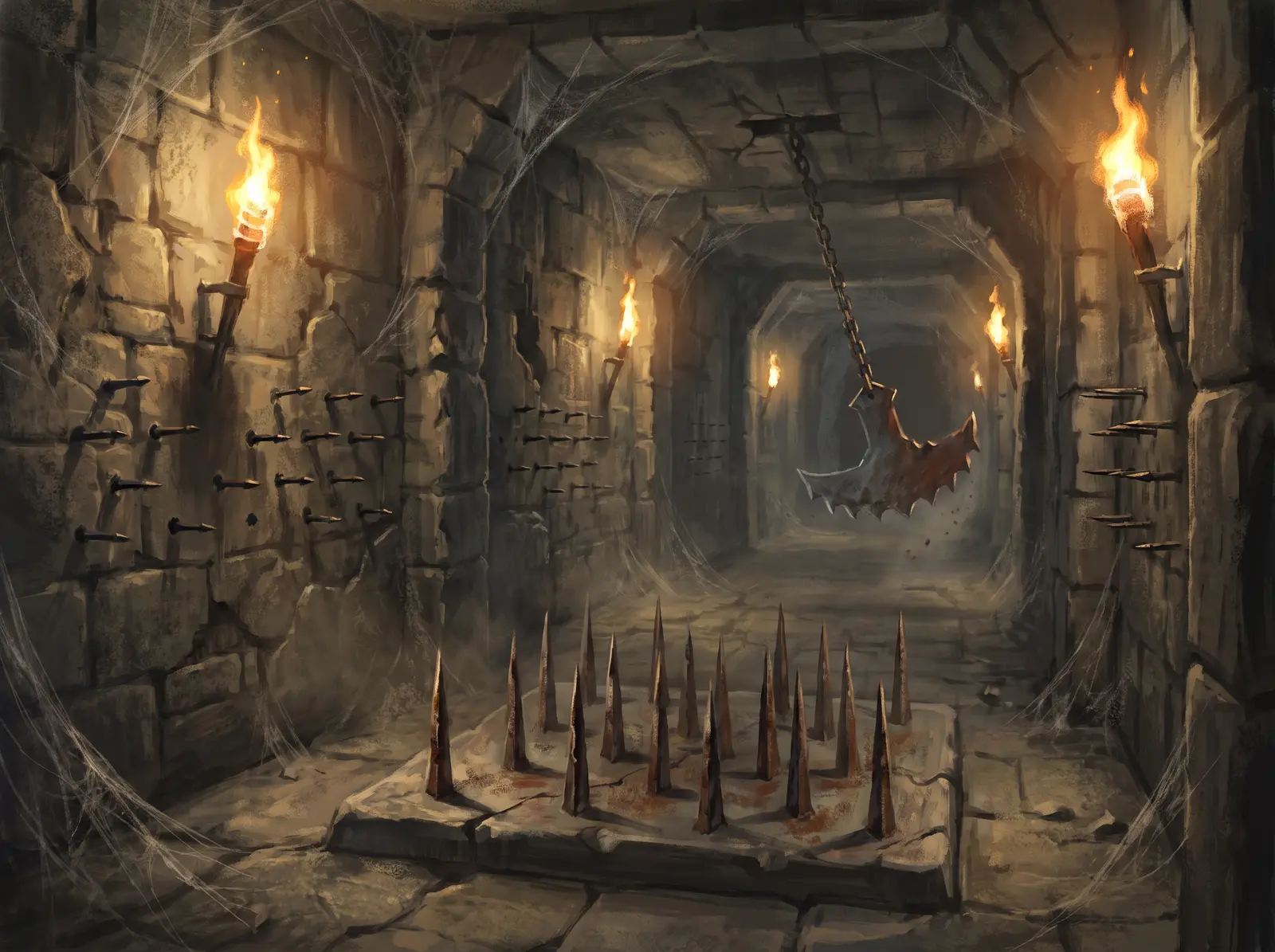
Reading the approach
As you close on a dungeon, Daggerfall flashes a message for two or three seconds telling you what kind of hole you have found. This is the highest-value three seconds in the game, and most players let it scroll past unread.
What the messages actually say
A Vampire Haunt shows a message about a huge bat flapping slowly overhead, or dry bones littered everywhere. A Mine shows deep ruts scored into the ground. A Laboratory shows a green haze that makes your eyes burn. Each type has its own phrasing, and once you have seen a dozen you will recognise a type from half a sentence at sixty paces.
Turning text into triage
Build the reflex in three tiers. Vampire Haunt, Desecrated Temple and Laboratory mean prepare for casters and burst damage: drink a potion and do not stand still. Mine, Natural Cave and Volcanic Cave mean terrain will kill more of you than monsters will, so bring a levitation potion. Ruined Castle, Giant Stronghold and Prison mean large crews in small rooms: fight at the doorway, not in the corridor behind you.
Vampires do not appear in dungeons until your character is level 9. At level six, a Vampire Haunt is not the run you wanted.
Anatomy of a dungeon
Daggerfall dungeons are not hand-built levels. They are assembled from a grid of up to 32 blocks, where every block is a 2D cell whose four diagonal edges are double doors. Understanding that turns a confusing maze into something you can navigate.
Interior blocks and border blocks
Internal blocks become rooms and halls. Border blocks become single reflexive corridors, meaning the corridor loops back into itself rather than leading anywhere useful, and they carry no quest objects at all. When a hallway goes nowhere, you are on the rim. Walk inward instead.
One way in, one way out
Every dungeon has exactly one entrance and exit, marked with a green dot or green tag. This is the fact that should govern every decision you make underground. There is no fast travel back to the entrance and no resting to reset the run. Your decision to push on is genuinely the last decision in the expedition.
A steep incline usually marks a reflexive connection back into the room you came from. That is a gift: it means a blocked corridor is not a dead end and the map in your head still applies.
Finding them
At the start of the game only Privateer's Hold and Common Cemeteries are marked on your map. Everything else you find by one of five routes, and they rank roughly in this order.
- 1. Quest information
- The most common route by a wide margin. Quest-givers hand out dungeon locations directly, and a dungeon quest also tells you what is inside before you arrive.
- 2. Wilderness exploration
- Walking off the road turns up barrows, caves and ruins constantly, because there are 4,229 of them on an enormous map.
- 3. Dungeon maps
- Looted from enemy bodies or found in dungeon loot. A map for a type you have never cleared is worth more than gold.
- 4. Quest rewards
- Mostly the Fighters Guild, which hands out dungeon maps and locations as a matter of routine.
- 5. Guild promotion rewards
- The Thieves Guild and the Dark Brotherhood award dungeon maps and maps to rich locations as you rank up.
Learn the surface signs too. Mines leave ruts, barrows sit on visible mounds, and ruins show walls from a distance. Our travel guide covers the overworld routes that get you to a dungeon mouth in the first place.
Where the money is
Loot tables differ per dungeon type, and the naming is deliberately misleading. A Coven sounds like a witch's tower and yields 20 to 80 gold on table Q. A Crypt, a Desecrated Temple and a Vampire Haunt all share table K, which yields 1 to 10 gold alongside five armour, five weapon, three magic, five book and one hundred holy entries. Ruined Castles and Cemeteries share table N at 1 to 80 gold.
Dragon's Den table S, at 50 to 125 gold, is the best gold table in the game. There are 49 of them. Plan accordingly.
| Dungeon type | Table | Gold range | Read on it |
|---|---|---|---|
| Dragon's Den | S | 50 - 125g | Best gold in the game, only 49 in the Bay |
| Coven | Q | 20 - 80g | Best clothing drop weight of the humanoid types at 35 |
| Ruined Castle | N | 1 - 80g | Volume, not consistency |
| Cemetery | N | 1 - 80g | 774 of them; rolls average out |
| Crypt | K | 1 - 10g | 5 armour, 5 weapon, 3 magic, 5 book, 100 holy entries |
| Desecrated Temple | K | 1 - 10g | Same table; count is not value |
| Vampire Haunt | K | 1 - 10g | Same table; level 9 gate |
| Spider Nest | Clothing-heavy | Low | Clothing drop weight of 75 |
| Scorpion Nest | Clothing-heavy | Low | Clothing drop weight of 75; Hammerfell only |
Coven's clothing weight is 35 and both Spider and Scorpion nests carry 75, so if you are hunting a robe rather than gold, the spider holes are the correct target and covens are a compromise. Remember too that vendors pay a fraction of value.
The level 17 ceiling
Spawns are fixed per block per level, and they freeze once your character reaches level 17. Above that ceiling, clearing the same dungeon again produces the same enemies at the same strength.
That makes the arithmetic brutal. Farming a Crypt you found at level 8 while you are level 30 is not grinding, it is taking a fixed stipend of one to ten gold per run. The ceiling does not mean stop playing dungeons; it means the source of progress changes from "the same hole, tougher" to new locations, higher-level dungeons, guild rewards and artifacts.
The commonest wasted afternoon in Daggerfall is level 25 in a level 10 dungeon, repeating a route that stopped scaling eight levels ago. Check the dungeon level before you commit the evening.
Traps, teleporters and the void
The hazards inside a dungeon are not damage sources. They are information problems, and the discipline is reading them before they resolve.
Reading a trap before you hit it
Watch for a swaying screen combined with draining health or magicka when there are no monsters on screen. That pairing means a trap is close. If you ignore both halves of that signal, you are choosing to be hurt for free.
Red brick doors and teleporters
Red brick doors teleport you or hurt you, with no visual tell that distinguishes the two. Save before you touch one, and treat every red brick as a checkpoint boundary rather than a shortcut. Teleporters such as the floating skull can move you across the dungeon's map without warning, so you should already know what your exit looks like before you cross one.
Water and swimming
Underwater swimming works only inside dungeons. You control it with Page Up and Page Down and you get a breath meter. Above ground you cannot submerge at all: rivers on the surface are scenery, flooded vaults below are obstacles. A breath meter is a hard timer and the only counter is a water breathing potion, which our alchemy guide covers.
Drowning counts. Running out of breath underwater is not a reload-safe mistake, and neither is a health total of zero. There is no resurrection in this game, so treat every breath meter as a countdown you cannot outrun.
Fighting underground
Dungeon fights are not open-ground fights, and the tactical details that make them survivable are small and specific.
Lure them into pits
Enemies take no fall damage in pits and they do not drown. A pit is a free damage trap you can set up with your back against the doorway, and it works on giants, orcs and undead alike.
Hit, then back up
Hit-and-back-up spacing is the baseline. Corridor and doorway fights have no room for a monster to swing without you having somewhere to retreat to, and the retreat is what creates the next opening.
Stunlock and Invisibility
At point-blank range, stunlocking shuts down casters entirely, which is why the Vampire Haunt triage advice is to close distance before the first spell goes off. Cast Invisibility from five to ten paces and monsters will often lose track of you entirely, which is the difference between a fight and an ambush. See our spellmaking guide for how to build it.
The artifact hunt
Artifacts are the reason people clear a hundred bad Crypts for ten gold each. There are seven Unaligned artifacts and sixteen Daedric ones: Unaligned artifacts are attainable through normal play, while most Daedric artifacts sit behind fixed quest chains.
The seven Unaligned
- Auriel's Bow
- Auriel's Shield
- Auriel's Lord's Mail
- Chrysamere
- Necromancer's Amulet
- Staff of Magnus
- Warlock's Ring
The sixteen Daedric
- Azura's Star, Ebony Blade, Ebony Mail, Hircine Ring, Mace of Molag Bal, Masque of Clavicus Vile, Mehrunes' Razor, Oghma Infinium, Ring of Khajiit, Ring of Namira, Sanguine Rose, Skeleton's Key, Skull of Corruption, Spell Breaker, Volendrung, Wabbajack
Most Daedric artifacts list at 50,000 gold, so no shop will sell them at any price. Skeleton's Key lists at 1,800 and Warlock's Ring at 3,490. The Oghma Infinium is a single-use magic book granting 30 attribute points. The Necromancer's Amulet, Staff of Magnus and Warlock's Ring are only offered with community fixes applied, and the Wabbajack crashes the game in early versions.
Note what that implies underground. You are not rolling for artifacts in a random barrow. You are clearing dungeons to fund the guild fees and travel that lead you to the quests where artifacts live.
Exploits, labelled as such
The following are save-scumming behaviours, not gameplay. They work because Daggerfall rerolls content on load.
Reload rerolls loot
Reloading a save rerolls loot containers and corpses. Save, reload, reopen, take, repeat.
Shop stock rerolls on re-entry
Enter a town, save in a nearby building, then enter a store. Stock is rerolled, which is why a shop can hold an item that was not there ten minutes ago.
Inn footlockers
Inn footlockers can hold Daedric weapons. Take one, reroll it, deposit it into a wagon, recall it back out, and sell it at the worst-quality shop you can find. This is the Rusty Ogre Lodge trick and it is pure duplication-flavored nonsense.
Pickpocketing dungeon NPCs
Dungeon non-player characters respawn every time you reload the cell, so pickpocketing them is effectively unlimited practice. It is the fastest way to raise the skill and it is not a supported progression route.
Save-scumming does not protect you from the death rule. Rerolls happen on reload, not on death, so a run that ends at zero health ends at zero health no matter how many containers you rerolled.
Dungeon questions
How many dungeons are there in Daggerfall?+
There are 4,229 dungeons in the game across 19 types. Castle Daggerfall, Palace Sentinel and Castle Wayrest are built as Human Strongholds but sit inside cities, so they have no map marker and cannot be picked out on the world map.
Why do I stop finding stronger monsters in dungeons?+
Because spawns are fixed per block per level and freeze once your character reaches level 17. Above that, progress has to come from new locations, higher-level dungeons and artifacts rather than from clearing the same barrow again.
Which dungeon types have the best loot?+
Loot tables differ per type and the loud-sounding ones are often poor. A Coven table Q yields only 20 to 80 gold, a Crypt, Desecrated Temple or Vampire Haunt table K yields 1 to 10 gold, and a Ruined Castle or Cemetery table N yields 1 to 80 gold. A Dragon's Den table S is the best verified gold in the game at 50 to 125, and there are only 49 Dragon's Dens in the Iliac Bay.
How do I tell what kind of dungeon I am walking into?+
On approach, Daggerfall flashes a message for two to three seconds naming the type. A Vampire Haunt shows a huge bat flapping overhead or dry bones everywhere, a Mine shows deep ruts scored in the ground, and a Laboratory shows a green haze that makes your eyes burn. Reading those three lines is the fastest triage in the game.
Ready to take it underground? Start with our character creation guide, then read our combat guide for the melee fundamentals that make a level 5 Crypt survivable.
Load a save and open a door
Daggerfall is free to play in your browser, no download and no install. Load a save, walk out of Sentinel, and take the first barrow you can find with a full potion belt and a saved game.