The creation screen decides the game
Character creation in Daggerfall looks like it belongs to a smaller, kinder game: pick a race, pick a class, name yourself, get on a boat. It is not. This screen is the whole foundation of your character, and Daggerfall never lets you change your mind afterwards. No respec, no level-up tree, nothing.
Three systems start here and never stop running. Your attributes decide damage, hit points, encumbrance and spell points. Your skill picks decide how fast you level, because levelling reads specific skills and nothing else. Your class restrictions decide which disadvantages you live with. The common first-time mistake is treating this screen as flavour, then wondering why levelling stalled at level 12.
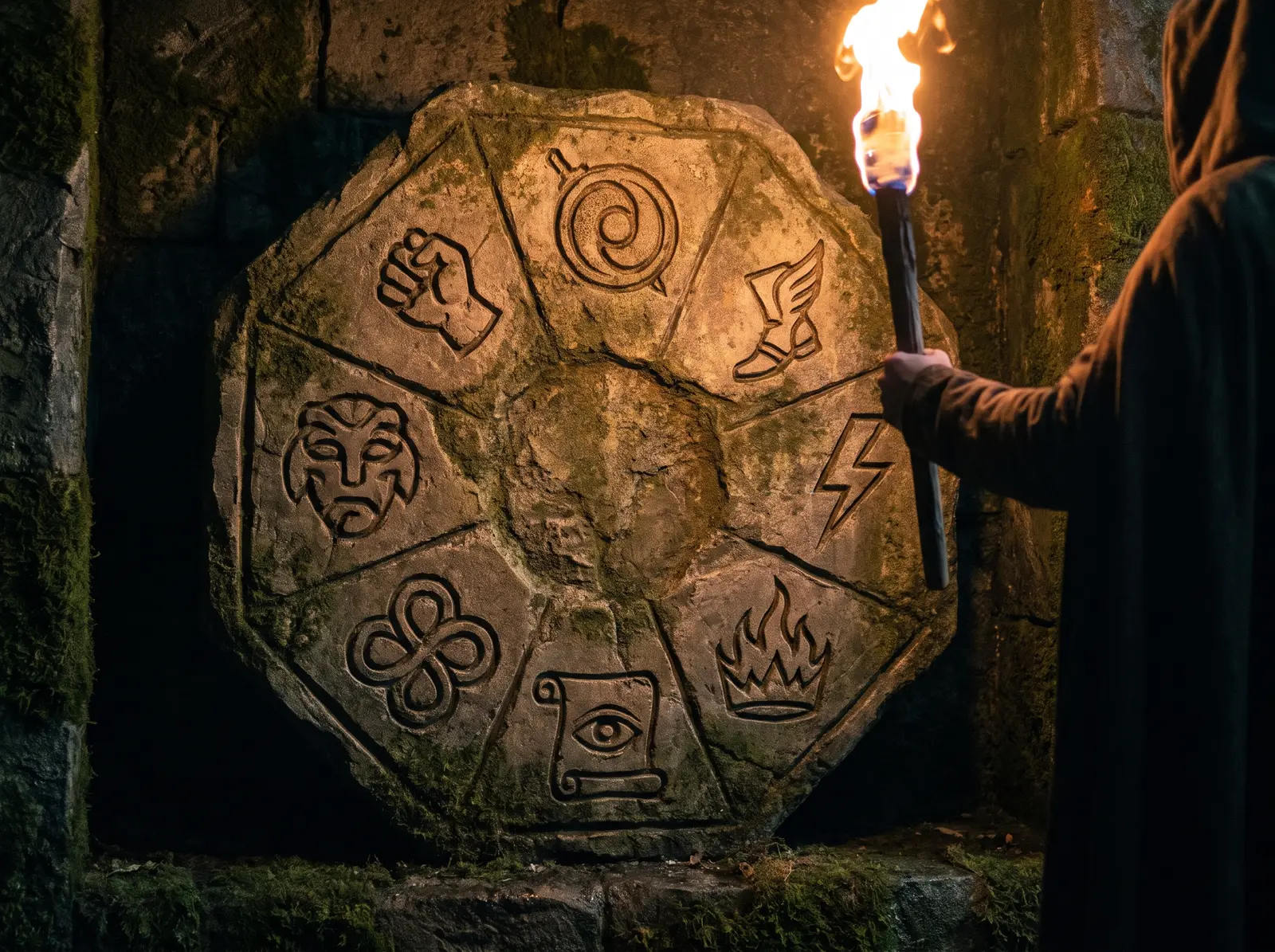
Pick a class whose hit-point rate and restrictions you understand. Spend your free points on Strength and Endurance. Make sure your three Primary skills are things you will train for the rest of the game. Ignore the racial attribute lore completely.
The seven creation steps
Classic Daggerfall walks you through seven screens. Knowing what each one actually decides saves you an hour of staring at menus.
| STEP | WHAT YOU SEE | WHAT IT REALLY DECIDES |
|---|---|---|
| 1. Race & Gender | Eight races, gender choice | Your one Special Advantage. Gender is cosmetic. |
| 2. Class | 18 classes or custom | Hit points per level, starting skills, restrictions. |
| 3. Background | A list of origins | Bonus skill points. The one step close to pure upside. |
| 4. Name & Face | Name and face sliders | Nothing mechanical. |
| 5. Attributes | Eight numbers in a ring | Damage, hit points, encumbrance, fatigue, spell points, resistance, movement. |
| 6. Skills | 35 skills, add and remove counters | Your levelling rate. The most important screen in the game. |
| 7. Reflexes | A bare speed scale | Only your own skill-advance rate. Enemies are always at maximum speed. |
Step 1: Race
The race screen looks like it should be the start of your build. It is not. Daggerfall has eight races, and the only gameplay effect each one gives you is a single Special Advantage. The racial attribute adjustments published alongside the game were never implemented in code, so a Nord does not actually get free points or a Health bonus. That table in the Chronicles is fiction. Pick the race whose advantage you want and move on.
Step 2: Class
This is the heaviest decision in the game. A class is three things at once: a hit-point rate per level, a set of starting skills, and a list of restrictions. A Monk can never wear armor. A Sorcerer can never regenerate magicka. A Knight can never cast Daedric spells. Because every class totals exactly 400 attribute points, none is "more" in the budget sense. They are equal, differently shaped.
Step 3: Background
Backgrounds add points to skills rather than taking them away. Take whatever helps your Primaries or your best Majors. It is the one step where the correct choice is obvious on the first read.
Steps 4 to 7
Name and face are cosmetic. Attributes and skills are covered below. The Reflexes step deserves its own warning, because players expect a difficulty slider and Daggerfall does not have one.
Classic Daggerfall has no difficulty setting at all. The Reflexes screen only changes how fast your own skills advance, and enemy speed is always maximum. If you want an easier game, choose your own challenge: play a heavily armoured class, carry extra healing, and avoid travelling alone at night.
The eight attributes
Every attribute starts at 50 in a custom class. You then get a random bonus of 0 to 10 per attribute plus 6 to 14 points you may allocate yourself, with a legal range of 10 to 75 at creation and a hard cap of 100 later. You can never max everything.
| ATTRIBUTE | EFFECT | WORTH POINTS? |
|---|---|---|
| Strength | Melee damage modifier of (STR minus 50) divided by 5. Max encumbrance equals Strength times 1.5. Max fatigue equals Strength plus Endurance. | Yes. Damage and encumbrance in one stat. |
| Endurance | Hit points per level modifier of (END minus 50) divided by 10, plus faster healing and longer breath. | Yes. Your survival stat. |
| Agility | Intended to improve hit chance. That modifier is broken and does nothing. | No. Dump it. |
| Speed | Movement speed, weapon swing speed, reload time. | Quietly excellent. Great for a bow or dagger. |
| Willpower | One extra point of spell resistance per 10 points. | Yes if spells get cast at you. |
| Intelligence | Spell points equal 0.5 times Intelligence. Increased Magery raises the multiplier to 3. | Casters only, with that advantage. |
| Luck | Contributes to hit chance. Not to loot quality. | Minor. Ignore the treasure myths. |
| Personality | NPC reactions and prices only. | Only for a persuader. |
What a skill's governing attribute is worth
Next to every skill you will see a governing attribute: Strength governs Blade, Intelligence governs Sorcery, and so on. This is flavour text with no mechanical effect whatsoever. Training Blade never adds a point of Strength. Do not build around it.
"Raise Strength to train Blade faster." There is no such rule. Skill speed comes from practice time and your Reflexes setting.
How the reroll screen really works
The attribute step is where most first-time players waste an hour, because the screen never explains what it is doing. Here is the mechanic in full.
What you are given
Eight attributes starting at a base of 50, a random bonus of 0 to 10 rolled per attribute, between 6 and 14 points you place by hand, a legal range of 10 to 75, and a reroll button.
Why the reroll matters so much
That 0-to-10 roll is pure variance. Roll three times and the same class will give you a 61 in Endurance, then a 58, then a lucky string where three attributes land above 8. Because you cannot edit a character later, this is your first real decision in a game with no undo.
Save before you roll, then reload until you like the numbers. Comparing results that way is safer, because you cannot accidentally confirm a half-finished allocation.
Budget planning
Spend your free points where the curve is steepest. Strength at 65 gives a damage modifier of 3, a 30 percent improvement over 50. Endurance at 65 adds 1.5 hit points per level, which compounds for the rest of the game. Compounding stats win; dump stats like Agility waste your one good decision.
- BASE ROLL
- 0 to 10 random bonus points per attribute, rolled independently.
- FREE POINTS
- 6 to 14 points you place by hand, anywhere from 10 to 75.
- TOTAL BUDGET
- Exactly 400 attribute points for every predefined and custom class.
- HARD CAP
- 100 per attribute later in the game, not 75.
- SKILL COUNT
- 35 skills ship in the game. Disguise, Elvish and Faerie were cut before release.
35 skills and the 15-point rule
Here is the fact that changes everything: Daggerfall has 35 skills, not the eight you may have read about. They are grouped as Combat, Magic, Stealth, Social, Academic and Athletic. In a custom class you pick 3 Primary, 3 Major and 6 Minor; a predefined class fills the same slots for you.
Starting skill values
Values depend on the slot: Primary 25, Major 15, Minor 10, everything else 0. Backgrounds add on top, and some give a flat random roll of 3 to 6 instead. Read the number before you commit.
The formula that decides your speed
Your level is floor((S - S0 + 28) / 15). S is the current total of your three Primary skills, your best two Major skills and your best one Minor skill. S0 is that same total at character creation. Every other skill you train is ignored, no matter how good you get at it.
So you do not level by being a generalist. You level by pushing up a fixed set of eight skills and letting the other twenty-seven rot. Level 2 needs only 2 points of progress, so everyone gets an early, cheap level. After that the threshold is 15, and typical maximum level is 29 or 30.
Put all eight of your levelling slots in skills you enjoy using in combat. A Primary skill you never touch is worse than no skill at all, since it contributes a constant to S that never grows.
The six-hour cooldown
Every skill has a six-hour real-time cooldown between advances. That is why your character is not finished when you reach Skingrad. Plan your training route around time, not around levels.
All 18 classes compared
Eighteen predefined classes ship in the game: Acrobat, Archer, Assassin, Barbarian, Bard, Battlemage, Burglar, Healer, Knight, Mage, Monk, Nightblade, Ranger, Rogue, Sorcerer, Spellsword, Thief and Warrior. Warrior is the only class with no restrictions at all.
| HP PER LEVEL | CLASSES | FEEL |
|---|---|---|
| 25 | Barbarian | Tank. Poison immunity, no Orcish or Daedric. |
| 20 | Warrior | No restrictions. The safe default. |
| 18 | Knight, Ranger | Heavy armour and bow comfort. |
| 16 | Archer | Fragile up close, superb at range. |
| 14 | Monk | No armour; durability from skill. |
| 12 | Assassin, Rogue, Spellsword | Damage dealers who must avoid hits. |
| 10 | Thief, Battlemage | Thieves avoid; battlemages cast. |
| 8 | Acrobat, Bard, Burglar, Healer, Nightblade | Low, but each gains what the number cannot show. |
| 6 | Mage, Sorcerer | Glass. Huge spell pools, no margin. |
Spell point advantages worth knowing
Mage gets 2 times Intelligence in spell points. Sorcerer gets 3 times plus Spell Absorption, but can never regenerate magicka. Battlemage and Healer get 1.75 times, Nightblade and Spellsword 1.5 times. Everyone else falls back on the base 0.5 multiplier, which is why a plain Knight casting spells runs dry in two fights. Read the spellmaking guide before you commit to a caster.
Restrictions as a design tool
Read restrictions as part of the class, not as a drawback to work around. A Monk's inability to wear armour is a real cost and stays a real cost. You are not choosing between good and bad classes; you are choosing which bad thing you would rather have.
Races and Special Advantages
Each of the eight races grants exactly one Special Advantage, and that is the entire gameplay content of the race system. Choose for the advantage, or choose for the face and the name, which are equally valid reasons in a 1996 RPG. Whatever advantage you pick, enemies come in packs from the deeper dungeon levels, and a Special Advantage rarely stops the things that actually kill you.
On a first playthrough, choose the race you like best and stop thinking about it. Any guide that ranks races by strength is describing a spreadsheet, not your experience.
Custom classes and the ClassMaker exploit
The custom class option lets you build anything: 3 Primary, 3 Major and 6 Minor skills, up to 7 advantages and up to 7 disadvantages. Advantages sound good and are not. Advantages make you level slower. Disadvantages make you level faster. So the optimal custom class is deliberately hobbled. Take the disadvantages that do not hurt you, refuse the advantages that only look impressive, and pick eight levelling skills you will enjoy using in a fight. When you shop for your first real equipment, remember that Strength sets your encumbrance ceiling at 1.5 times its value.
The ClassMaker exploit
On the attribute allocation screen, pressing U resets the add and remove counter, which lets you set every attribute to 10 or to 75 and walk away with an illegal character. It is a genuine exploit in the original game, not a fan-module trick.
Should you use it? For a science run, yes. For a first playthrough, no. A character with 75 across the board trivialises the first ten hours, then hits the same 15-point wall with attributes already solved. You lose the only part of Daggerfall that is actually a decision.
Three builds you can copy
These three characters are tested against the systems above: the 15-point rule, the hit-point rates, the class restrictions and the attribute formulas.
| BUILD | PRIMARY (3) | MAJOR (3) | MINOR (6) | GOOD AT | BAD AT |
|---|---|---|---|---|---|
| A. Pure Fighter Barbarian | Blade, Blunt, Archery | Block, Dodge, Athletics | Stealth, Running, Climbing, Swimming, Repair, Streetwise | Tanking everything. 25 HP per level, poison immunity, huge encumbrance. | No spell points worth the name, slow, and no Orcish or Daedric, so some dungeons are closed to you. |
| B. Mage-Thief Nightblade | Alchemy, Illusion, Mercantile | Alteration, Mysticism, Thievery | Blade, Dodge, Stealth, Detect Life, Athletics, Repair | Solves its own hit points with potions. Cheap, flexible, rarely takes the hit. | 8 HP per level, so one bad patrol ends you. Weak in melee if Stealth fails. |
| C. Honest Oddball Custom, no magic | Running, Climbing, Swimming, Stealth, Repair, Dodge | Block, Athletics, Blade, Detect Life, Mercantile, Thievery | Short Blade, Blunt, Archery, Beastmaster, Streetwise, Etiquette | The open world. Fast, silent, can go anywhere without magic. | No healing beyond potions, no magical shortcuts, and a slow ramp to damage. |
A. Pure fighter: the Barbarian who never dies
Put your free points into Strength and Endurance. Strength at 65 gives a melee damage modifier of 3 and an encumbrance ceiling of 97.5 before a single piece of armour. Twenty-five hit points per level is the best rate in the game, and poison immunity deletes a whole category of dungeon hazard.
Bad at exactly one thing: no magicka, and no Orcish or Daedric spells, so the shortcuts those schools normally provide do not exist for you.
B. Mage-thief hybrid: the Nightblade who heals himself
Alchemy in your Primaries means you carry your own hit point regeneration, which makes a low 8 HP per level far less frightening than the table suggests. Thievery and Stealth in your Majors let you leave a dungeon instead of fighting out of it.
Bad at sustained melee against anything faster than you, and at any fight where you run out of potions. Buy ingredients constantly.
C. The honest oddball: no magic at all
Fill your slots with athletics and stealth skills you will genuinely use, accept disadvantages instead of advantages, and play someone who solves problems with doors, cliffs and nerve rather than fireballs.
Bad at the first two dungeons, which are tuned for characters with combat skills or magic. You stay slower and weaker than build A until roughly level 15, then you stop dying outdoors entirely, which is worth the ugly middle.
Confirm your three Primary skills are the ones you will train, since they carry the most weight in the level formula. Then read the beginner's guide for route planning, and pick a guild that matches what you levelled.
Build it, then break it in.
Roll your attributes, pick your three Primary skills, and start walking south from Skingrad.
PLAY DAGGERFALLFrequently asked questions
Should I use the ClassMaker exploit in Daggerfall?
Only for a power fantasy or a science run. Pressing U on the attribute allocation screen resets the add and remove counter, letting you push every attribute to 10 or to 75. That trivialises the first ten hours and then hits you with the same 15-point wall. For a first playthrough, take Warrior or Barbarian.
What is the best class in Daggerfall?
There is no single best class, because every predefined class totals exactly 400 attribute points and the differences are restrictions plus starting skills. Barbarian, Warrior, Knight and Ranger give the most hit points per level and the fewest restrictions. Mage and Sorcerer multiply spell points but need hours of rest. Choose the fantasy you want and accept its weaknesses.
How do levels work in classic Daggerfall?
Your level is floor((S minus S0 plus 28) divided by 15), where S is the total of your three Primary skills, your best two Major skills and your best one Minor skill, and S0 is that total at creation. Level two needs only 2 points of progress, and typical maximum level is 29 to 30. A rare exploit pushes it to 32.
Does Agility affect hit chance in Daggerfall?
No, not in the original DOS release. The modifier that should make Agility improve your chance to hit is broken and does nothing. That is why players put early points into Strength for damage and Endurance for hit points, and treat Agility as a dump stat.